Taking part in the World Congress on Rehabilitation 2024
Yayoi Kitamura
Research advisor to the Assistive Technology Development Organization (NPO),
special-appointed professor at Nagano University of Health and Medicine
In this article, I talk about my impressions of the World Congress on Rehabilitation 2024 and one of the two lectures which I gave there. I introduced the other presentation in the December 2024 JANNET mail magazine.
Impressions
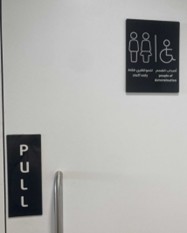
To begin with, the fact that disabled people have come to be known as People of Determination (POD) in the United Arab Emirates had already been reported in Japan (Terashima, 2020); however, this expression was not only used by presenters from the UAE but also written on signs in the toilets and at the airport. Fig. 1 shows the sign on the door of a toilet in a convenience store. In session 1a, it was explained by the Dubai Health Authority that “The meaning is that this term emphasizes not the limits on disabled people but their abilities and potential, reflecting a positive and empowering perspective.”
Fig. 1 Sign on a toilet door in a convenience store (suburbs of Dubai City)
Parallel session 1b “Empowering Diversity: A Joint Endeavor Of The Social Commission And Health & Functioning Commission For The Well-Being Of People Of Determination”
I took part in parallel session 1b in response to a request by the chair, Joseph Kwok, to the Japan Society for the Rehabilitation of Persons with Disabilities to send a speaker from Japan. The session had a broad framework, with five presentations. All the presenters apart from myself were of Chinese origin. The fact that all the session’s presenters spoke English fluently was one of my impressions. Unfortunately, the other presentations ran over time, and so the session did not go beyond an exchange of information. Three of the presentations were from the medical field. The first raised the issue of the need to respond to the rapid ageing of China’s population. The second was a report of the use of robotic harnesses to protect the trunk. The third talked about how “If we continue to give botulinum toxin injections to children with cerebral palsy who are unable to walk at a time which suits families, we can create periods during which they can walk with assistance.” I remembered that I had heard how Daisuke Tenbata, a member of the House of Councillors, had been given botulinum toxin injections (which were not covered by insurance) directly after his injury, and learned that various replication studies were taking place in China. Councillor Tenbata explained that since he could not continue this in the long term, he had moved to a strategy of changing his way of living, an example of making use of the social model. The fourth presentation was from the social sciences and talked about experiences of supporting decision-making in order to stay in employment. I talked about holding remote evacuation drills organised autonomously by a group, together with Hiromi Ichikawa, Home Careworker Coordinator at STEP Edogawa. I will give an overview in the next section. A detailed report has been published as a series in New Normalization (May, July, and November 2024 issues).
Three remote evacuation drills by an autonomous group
STEP Edogawa is an independent living centre in Edogawa Ward, an area 0 metres above sea level. The centre dispatches home careworkers to around 50 users. Most of the five surrounding wards flood, and in some places the water is forecast to take over two weeks to go down from a height of 10 metres. For this reason, it is recommended that each resident evacuate to outside these wards. Given this, Ms. Ichikawa is making preparations for community evacuation as a group by the centre, including users, their families, careworkers, and their families.” For severely disabled people, being able to secure careworkers who are accustomed to caring for them is a necessary condition for a stable life. Moreover, since the careworkers and their families would also need to evacuate, she thought that evacuating together would be logical for business continuity. I introduced the three trial runs which took place in order to make this a reality. Only 3 members of staff evacuated in advance of the typhoon which hit eastern Japan in October 2019, but following the timeline of forecasts and advisories from that occasion, 12 people, mainly staff, travelled to an accessible guesthouse in Kiyosato (Yamanashi Prefecture) in December of the same year. The reason for the choice was that staff of STEP Edogawa already had experience of using this guesthouse and knew what it was like. Since it was located in a resort, they thought that there might also be other accommodation facilities capable of accepting them. As the result of trialling two means of transport, a limited express train and a vehicle belonging to the centre, difficulties with travelling by limited express came to light. It took two hours the previous day to reserve seats, and they also needed to line up at the counter on the day of travel. There were only two wheelchair spaces on the whole train, in the carriage with an accessible toilet, and with two wheelchairs on board, there was not enough space for the refreshments trolley to get past, so when the trolley came along, the wheelchairs had to be moved. This experience became the basis for subsequent improvement of the wheelchair spaces on shinkansen. Two wheelchairs could not fit at the same time into the elevator in the station where the group changed trains, and the arrival station was unmanned after 5 p.m., so there was no-one to put in place the ramp between the train and the platform. In the 2022 trial, two buses were chartered to take a large group of 42 people to a former elementary school in the same area. The group included an ALS*1 patient on a ventilator. The centre had rented futons from a business in the evacuation destination, and ordered meals.
The evacuation venue was set up with the cooperation of students from a nearby university, arranged via one of the professors. There were three advantages to this arrangement: (1) the availability of care workers was assured, (2) since the families of the care workers came with them, they were able to devote themselves to their work in peace of mind, (3) by actually experiencing the situation, everyone was able to gain a concrete image and come up with ways of addressing issues, and the users became more positive about preparations.*1
Translator’s note: Amyotrophic lateral sclerosis, a form of motor neurone disease On the other hand, disadvantages also became apparent.
Firstly, coordination of who would take part in the group evacuation was possible precisely because it was a drill. Even if departure were to take place 12 hours before a typhoon was due to make landfall, after a press conference by the Japan Meteorological Agency, it was thought to be difficult to make the arrangements for a group evacuation in four days. Secondly, the cost of arranging buses, bedding, and meals was 900,000 yen, which was covered by a grant of 450,000 yen and a fee of 10,000 yen per participant; holding an annual drill would be too great a burden for the centre in terms of both money and time. Moreover, only four wheelchairs could ride on buses equipped with lifts. Thirdly, there were regulatory limits on the working hours of careworkers, meaning that they could not cover the work of preparing for the evacuation and travelling. In 2023, we rented a meeting room for community partnership activities belonging to a university located on a hill in the municipality next to the one in which the centre was located. With the participation of 72 people in total, 11 users stayed overnight and a further 8 came for the day. 2 ALS patients on ventilators participated. Since bedding, meals, and return transport were left up to each person in this drill, the burden on the centre was reduced. Moreover, the participants’ awareness of making preparations improved, and there were reports that the failures of the previous trial had been overcome. Participants were also able to compare the bedding and other items which they had brought. However, four issues remain. Firstly, the burden on each evacuee increased.
Secondly, there is no guarantee that this venue could be used for evacuation in an emergency, and so there is a need to secure an evacuation site. The five wards of the Koto district of eastern Tokyo have made an agreement with the Tokyo Metropolitan Government to use the National Olympics Memorial Youth Center as a remote evacuation centre, and are in the process of concluding agreements with public welfare facilities, but drills by each of these facilities are the next issue. There are plans to make agreements not only with public institutions in neighbouring municipalities but also with individual private institutions and centres, but it has been pointed out that collaboration with the local governments in which these centres are located is needed. The third issue is increasing the number of participants in the drills. Only 20% of the centre’s total users took part in the 2023 drill. The fourth issue is building relationships between the users and their neighbours.
This is because, even with evacuation in advance of a disaster, it has become clear that the regular home careworkers cannot provide all the time needed for preparations and travel: the need to communicate the difficulties to people living round about and ask for whatever help they can manage has been shown.
Reference
Akira Terashima, “Changing the term for ‘disabled people’ to ‘people of determination’ in the United Arab Emirates,” JSRPD blog, 22 January 2020
Edited and published by the Japanese Society for Rehabilitation of Persons with Disabilities.
Published on November 20th, 2024.