Individual visits by Ishinomaki Shoshinkai, a social welfare corporation in Ishinomaki City, after the Noto Peninsula Earthquake
Yoshikazu Hayasaka
Ishinomaki Shoshinkai Social Welfare Corporation
This article is a record of Ishinomaki Shoshinkai’s collaboration with individual visits taking place in connection with the Noto Peninsula Earthquake, which occurred on 1 January 2024. These individual visits were fundamentally the same as the activities carried out in the areas damaged in the 2011 Great East Japan Earthquake by consultation support centers in the Ishinomaki area in order to get a grasp of the situations of disabled people living at home. At that time, the visits received support from the NPO Nihon Soudanshien Senmonin Kyoukai (hereinafter, “NSK”) in the form of staff dispatch and coordination. This time, making use of the Project to Identify the Elderly and Others Affected by Disasters (Ministry of Health, Labor and Welfare), several agencies, support organizations, and networks worked together. NSK asked for our collaboration on the individual visits in late January. They asked us, with our experience of receiving support, for our help in providing support. The activities of our corporation took the form of collaboration with NSK, which aimed to support the area affected by the disaster, and with consultation support centers in this area: this was our repayment of the support which we once received from across the country.
On 12 February, a colleague and I set off from Ishinomaki City, Miyagi Prefecture, to Anamizu Town, Ishikawa Prefecture. Our journey along the Noto-Satoyama Kaido expressway, crowded with construction vehicles, and then down bumpy roads in remote Okunoto gave us a foretaste of the difficulties ahead. The center in Anamizu Town which we borrowed as the headquarters of our activities in Okunoto had also been damaged; the water supply had been restored just the previous day. Our support activities began under these circumstances. The staff dispatched by our corporation were made up mainly of current or former consultation support specialists, and we mainly visited individuals on the local authority’s list of people requiring assistance in order to gain an understanding of their situations, provide information, and enter the information about their situations into an electronic database. We made every effort to consistently provide two staff at a time throughout the period between 12 February and 31 March, without any breaks. A total of 14 staff were active over the 49-day period.
The confusion after the disaster and the “blank” in support – why specialist consultation support services were needed
There was one definitive difference between support in ordinary times and the situation which we confronted during this visit. This was the hard fact that those who would be responsible for providing support in the usual course of affairs – local government employees, the area’s consultation support specialists, welfare facilities, and many other people and objects – had been affected by the disaster. The area’s support functions as a whole had suffered major damage, so even though everyone did their utmost, manpower and information were severely lacking.
I remember that mid-February, when we began our activities, was a period in which people were starting to return from evacuation centers to live at home as the water supply was restored, although there were differences between areas. At first glance, this seems like a step towards recovery. However, looking at it from the perspective of support, it was also the transition period particular to major disasters in which the needs scattered from “points,” the evacuation centers, to broad “areas,” the local communities, and so became harder to grasp. It was also the period in which the local government contact points began to receive a deluge of diverse demands from residents, and so it was clear that all local authorities were struggling to respond.
Against this context, people who need support get left behind in a “support blank.” For example, the cessation of medications which some people had been taking regularly led them to experience auditory hallucinations and start to wander off. Even when this exceeded the family’s capacity to deal with, they could not reach anyone for help. It became difficult for people with lower-limb impairments who were unable to use the regular bathing facilities which had been opened to keep their bodies clean. There were people with mild learning disabilities who were continuing to live alone in houses which had been assessed as being at risk of collapse, and who told us that they did not know what to do first. I think that these are complex, highly individual needs, in a different dimension from simply “not having things” or “not having food.” The situation convinced me that the role of picking up on such circumstances and connecting them with appropriate support was exactly the mission which we, as professionals, ought to fulfil.
From “looking for support” to “connecting with support”
We carried out our activities in Anamizu Town, Noto Town, and Wajima City, Ishikawa Prefecture. Day by day, painstaking team action was a common point across all these areas. First of all, at our early morning meeting, we mapped out where we would visit, based on the information provided by the local authority about people requiring assistance and on information gained from our activities until the previous day, and decided on that day’s movements. In order to ensure safety and multifaceted perspectives, visits took place, in principle, in teams of two. Where possible, pairs were made up of a local specialist adviser, with their detailed knowledge of the lay of the land and interpersonal relationships, and a specialist adviser dispatched there, with an external perspective; they worked together to make the most of one another’s strengths.
These pairings were often game-changing for the support. Even relying on a map to make a visit, external specialist advisers dispatched on their own were not familiar with the area, and came up against a blank wall if the person was not at home. However, if they were accompanied by a local specialist adviser, care manager, or public health nurse, the situation was completely transformed. By asking about how things were in nearby evacuation centers or talking to the key person in the local area, we were able to gain valuable insights into the situation, such as “He’s apparently evacuated to Kanazawa, where he’s being supported by relatives” or “She just came home from the evacuation center yesterday.” As a result, the visit did not just end by “confirming the person’s absence,” but allowed us to update ourselves with live information which led to the next step.
Our main role was not to directly provide the final service. We took ourselves to where disaster survivors were, assessed the situation from an expert perspective, and organized our findings about “What was causing problems and why” and “What kind of support would be effective” in order to give a report. We then reliably “connected” this accurate information to the local governments who would be central to responding. Providing information to the disaster victims was also an important activity, but this required extremely careful consideration. Each local authority communicated different information to their residents at different times, and so where information about disaster victim certification was being given in stages, village by village, for example, we were instructed to refrain from saying anything definite even if we were asked, in order to avoid confusion. On the other hand, we listened carefully to the status of aid delivery or inconveniences in daily life, and were often asked to ensure that information which would be useful right away was delivered, such as letting people know about clean-up volunteers or giving information about on-demand buses to ensure that they had a means of transportation. What greeted us most often when we reached our visit sites were pressing questions: “Have they been here to assess whether my house is going to fall down?” “If not, when will they come?” We could not answer these questions directly, but we could empathize with their feelings of anxiety and listen carefully to what they said. We then told them just the accurate information which we had learned, working to be of some help to the survivors in overcoming these difficult circumstances.
Issues which became apparent through our activities, and proposals for the future
What we came up against in our activities was the fact that however meticulously you plan in advance, once disaster strikes and those responsible for support become disaster victims themselves, it is extremely difficult for the local community alone to provide the solutions.
From these experiences, what we would like to propose for the future is not a demand for improvement to particular policies or systems. Rather, it is the importance of people like us, with our experience of being disaster victims and then receiving support, continuing to tell society about this lived experience. I think that we should not only talk about how much we were helped by the support we received – our “gratitude” or “experiences of success.” At the same time, we have a responsibility to tell people faithfully about the reality of “hardships” and “dilemmas” that could not be resolved even though we received support, and the existence of “limits” which could not be filled in just by receiving support from outside.
This is because such unvarnished truths provide the best opportunity for other local authorities, support agencies, and businesses which have not yet suffered disasters, and the parties involved, to change their understanding of disasters from “someone else’s problem” to “our problem.” I hope that rather than just discussing the vulnerability of local systems, initiatives to raise the area’s “capacity to receive support” will spread more widely.
On that day, the baton of support, which was passed from Ishinomaki to Noto, will be passed on again for the next time via the hand of someone who reads this record. This is my greatest wish.
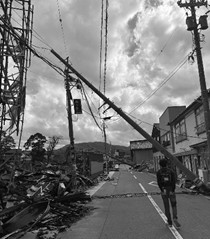
Damaged town, in Wajima